
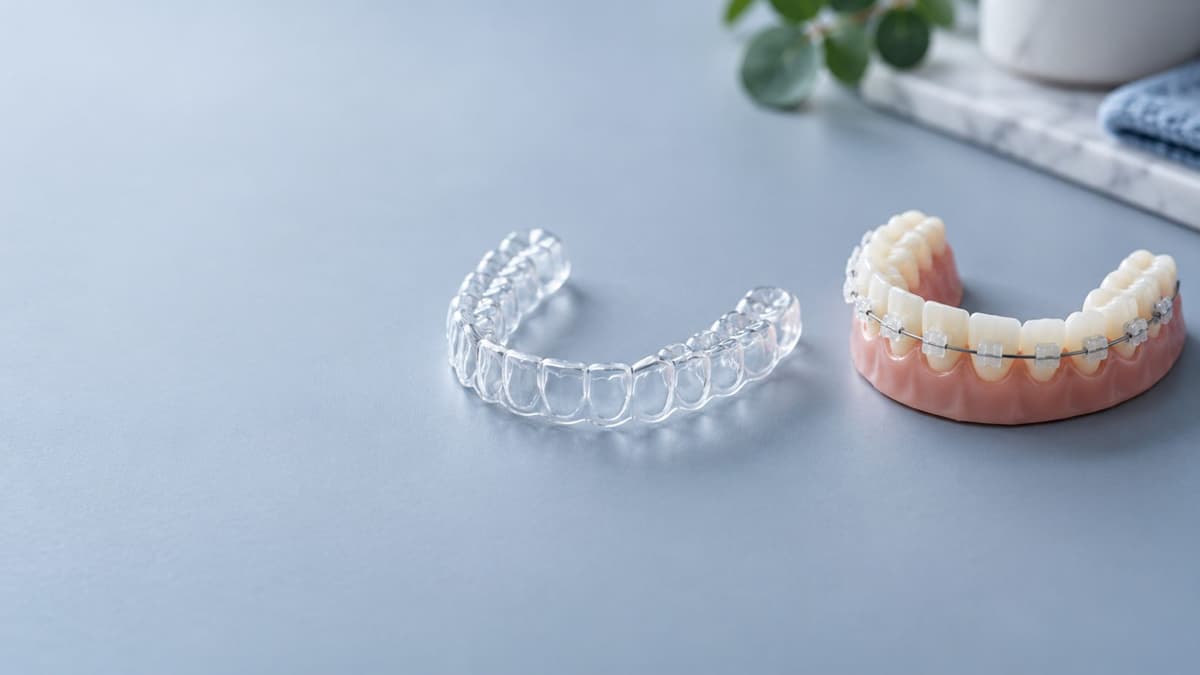
If your teeth are crooked, crowded or spaced, you have two reliable ways to fix them: fixed braces or clear aligners. Both work. The decision comes down to three things - how complex your case is, how much daily discipline you can manage, and your budget.
Here is how they actually compare.
How each one works
Fixed braces are small brackets bonded to your teeth and joined by a wire. The wire is adjusted every few weeks to move the teeth along a planned path. They are working 24 hours a day and there is nothing for you to remember.
Clear aligners are a series of near-invisible removable trays, each slightly different from the last. You wear each set for one to two weeks, then move to the next. They only work while they are in your mouth - which needs to be 20 to 22 hours a day.
Both are planned the same way at the start: an examination, photographs, X-rays and a scan or impressions, so your orthodontist can map out exactly how the teeth need to move.
What it costs in Noida
Prices vary with the clinic, the brand of aligner and - most importantly - how much tooth movement your case needs. As a guide to typical Noida ranges:
| Option | Typical range | Notes |
|---|---|---|
| Metal braces | ₹25,000 – ₹45,000 | Most cost-effective; visible |
| Ceramic braces | ₹35,000 – ₹65,000 | Tooth-coloured brackets; less visible |
| Clear aligners | ₹60,000 upwards | Higher for complex cases and premium brands |
A retainer after treatment is usually an extra ₹3,000 – ₹8,000 and is not optional - teeth drift back without one.
Aligners cost more because every tray is custom 3D-printed from a digital plan. That plan is also their advantage: you can see a preview of your likely result before you start.
At The Auraa Care you get a written estimate for your specific case after the assessment, so there are no surprises later. We also discuss instalment options for longer plans.
How long it takes
- Simple crowding or spacing: aligners around 12 – 18 months; braces around 18 – 24 months.
- Complex bite correction: braces are often faster and more predictable; aligners can take longer or need "attachments" and elastics to do the same job.
Minor front-tooth corrections can be quicker with either. Your orthodontist gives you a real estimate once they have seen your records - not a number over the phone.
What living with each is actually like
Braces
- Nothing to take out, nothing to lose - the result does not depend on your willpower.
- A little soreness for a few days after fitting and after some adjustments.
- You avoid very hard and very sticky foods, and cleaning around the brackets takes more care.
- Visible, though ceramic brackets are far less obvious.
Aligners
- Removable for meals, brushing and photos - and genuinely hard to notice.
- No food restrictions, and cleaning your teeth is normal.
- But they must be worn 20 – 22 hours a day. If they sit in a drawer, the treatment stalls.
- You will lose the odd tray - a replacement takes a few days.
When braces are usually the better choice
- Significant crowding, rotations or bite problems that need precise, forceful movement.
- Teenagers or anyone who would struggle to wear trays consistently.
- When you would rather not think about compliance at all.
When aligners are usually the better choice
- Mild to moderate crowding or spacing, especially in adults.
- Professionals and anyone who does not want fixed braces visible at work.
- People who are reliably disciplined about wearing them.
What both have in common
- They start with the same assessment - you cannot choose sensibly without it.
- Both need regular reviews (every 4 – 8 weeks) to stay on schedule.
- Both need a retainer for life, worn as advised, to hold the result.
- Both give a straighter, easier-to-clean set of teeth and a corrected bite when done properly.
What a good orthodontic consultation should give you
- A clear diagnosis with X-rays and a scan.
- An honest answer on whether aligners can do your case - not every case suits them.
- A realistic treatment time for each option.
- A written cost for braces versus aligners, including retainers.
- A recommendation, with the reasoning explained.
The bottom line
For mild to moderate cases in disciplined adults, clear aligners are comfortable, discreet and worth the extra cost. For complex corrections, or when daily compliance is a risk, fixed braces are more reliable and often faster.
The only way to know which is right for you is an assessment. Book a consultation with our consultant orthodontist at either of our Noida clinics - Sector 62 or Sector 74 - and we will show you both options, with timelines and costs, before you decide anything.
This article is general information, not a diagnosis. Your suitability for aligners or braces is confirmed at an orthodontic consultation.